



The formation of mould on leather shoes is a common problem especially in some parts of the world during some periods of the year, when humidity is high, but everyone can have mould issues appear on their shoes. Sometimes to a small degree but sometimes the whole shoes can become full of mould. Here I go through the reasons for why mould is formed, how you can avoid it, and how you remove it if you have footwear that gets affected.
Reasons that mould is formed on leather shoes
Mould is a collective name for a large number of fungus types that feeds off living materials. There are mould spores all around us all the time, but in some places they are gathered and can start growing to a larger degree, and that’s when they become problematic. On food it’s most common to find it, but as most know it can appear here and there. Among other things, on leather.

Mould formed in a pair of Allen Edmonds after they’d been out in heavy rain. Picture: Yap Han Wen / The Shoe Forum FB
When tanned the leather is treated in various ways to prevent the appearance of mould, but nonetheless it’s a living material, it also contains natural tannins and some natural waxes and oils to a small or large degree depending on leather type, it’s treated with other waxes and oils which is necessary to nourish it but also inevitably adds organic substances to the leather, and you can have stains etc. that can be another source for mould to grow on.
Then mould is most easily formed when it’s humid, dark and the air circulation is low. So, basically, to have wet leather shoes and place it in a sealed closet or similar is basically like begging for mould to be formed. Which leads us to the next part of this guide (focus here is on shoes, but basically goes for all products made of leather).
How to prevent that mould is formed on leather shoes
We have two main reasons that affect mould creation on leather footwear: the condition of the shoes, and the condition that they are stored in. Starting with the condition of shoes, if you’ve been out in heavy rain and your shoes are soaking wet, you really need to be extra careful. First, wipe them off with a damp dish cloth or similar to remove any dirt and residues. Do let them dry in an airy place, ideally outside during a sunny day (not always the case though if they’ve been soaked from rain, and they should not be outside in rain or during night since then humidity is higher), but inside in regular room temperature is fine as well. Do not attempt to have them dry faster on some kind of direct heat, like a radiator, floor heating or similar, it will stress the leather massively and in worst case it can crack. Make sure that air can circulate around the shoes, leave them laying on the side, standing on a non-even surface which lets air through, or solve a way to have them hanging. It’s quite common to find mould on leather soles, if they’ve become wet when walking in rain and stored on a flat surface with no circulation, it easily builds up since the soles often are dirty from much more than the uppers as well, stuff that mould spores like. Here how they are stored when whet is key.

Leather soles where mould have been created.
Do not insert shoe trees in the shoes if they are soaked, they will dry better without any shoe trees or with newspaper pages stuffed in them which can absorb moisture, and ideally be exchanged when the paper is totally moist. First once the shoes have dried up a bit you insert wooden shoe trees to retain the shape. Wooden shoe trees do absorb some moisture, and even more importantly lets the leather breath (compared to plastic shoe trees which clogs the pores), which is perfect after regular everyday use when the shoes are a bit moist from sweat, but as mentioned if they have become soaked even wooden shoe trees can prevent the leather to dry up properly.
For the condition to store shoes to prevent mould, there’s actually some common mistakes that is often done. Usually shoes are stored in a closed closet, which is not ideal since air can’t circulate in there. If you have them in a closet, try to create the possibility for an airflow, either simply by making sure to leave a door slightly open, or perhaps drill larger holes in hidden places. Also it’s best if they don’t stand on a solid flat surface, have a ribbed carpet or similar which lets air circulate under the shoes (read more in this article).

One solution to make sure air can circulate around the shoes is to have them standing on a rubber carpet like here.
A popular way to store shoes, especially during seasonal storage when they aren’t used, are in shoe boxes (read more about seasonal storage in this article). This can be problematic since that indeed is a dark space where air can’t circulate, especially if stored in for example a basement or a similar moist location (should be avoided), which could mean that mould can be created. Make a few of holes in the boxes to make it possible for air to circulate, to make the conditions better, and always make sure the shoes are completely dry before you stove them away in a box.
What is good is to have moist absorbers of some forms where one store the shoes, that can attract moist instead of having the leather of the shoes do that job. Wooden shoe trees do this job to some extent, and is enough in cases where it’s not too humid. For seasonal storage it could be good to add bags of cedar shavings and/or the classic bags of silica gel that you often find in packages you receive (don’t throw those away, put them in a box at home to have at hand when needed). In extreme cases, for example if you live in very humid locations, a dehumidifier can do a big difference, if it’s possible to solve in a practical way.
If you often experience problems with mould on your shoes, then you have to be more careful with all the things above. As mentioned, in some places of the world conditions are more humid and mould is more easily created, and it varies through seasons as well, and you can live in a house which has more problems with mould spores which will risk settle on your leather footwear. So you can learn when you have to be extra careful.
How to remove mould from leather shoes
It’s worth knowing that when you start to see mould, it has already been built up for some time. The first process is invisible to the eye, so when you start seeing the characteristically fuzzy, white (or sometimes black) coating, it has come a bit in its development. Take the shoes outside, since you don’t wont’t the mould spores to spread indoors, and wipe away all surface mould with a cotton cloth made damp with hot water. Do it carefully. Then let the shoes air dry, preferably outside.

Start with wiping away surface mould. Picture: The Spruce
Now you need to get rid of the mould that is deeper into the material, and which has been formed in cavities like around lacing holes and in between leather pieces etc. If it’s just on the leather soles, it’s easier, but same process. For this you need to use a substance that kills the mould. There’s a few cleaners which do this available, but the cheapest and best is regular vinegar. This is strong on skin, use gloves to protect your hands. If you want to make the smell less harsh, you can mix the vinegar with lemon juice. The liquid should contain about 12% vinegar, so if it’s stronger mix it with water to achieve a similar concentration, to not be unnecessarily strong for the leather. Again, do this outside. Dampen a cloth or a sponge with vinegar and wipe thoroughly over the entire shoes. Don’t miss the inside if there’s any trace of mould there as well, and for tight areas you can use a small brush. It’s important that you wipe the whole shoes so it will all become damp, to avoid water marks when the shoes dry again. Let air dry. Check the shoes to make sure you got rid of all the mould, otherwise wipe this area again with vinegar, you can try to do it more carefully to not need to wipe and dampen the whole shoes again.
Once you’ve gotten rid of all mould and the shoes are completely dry, the leather is quite strained and dried out, and needs to be conditioned. First apply one or two layers of a good conditioner, preferably a leather lotion or similar, but also renovateur work. Then at least a couple of thin layers of a good shoe cream, and if you wish you can go on with wax etc to restore the shoes to their original state. If all this is done properly the shoes should be back in a good condition again. Should you not be able to solve it yourself, take the shoes to a good cobbler or leather restorer.

Seriously mould affected boots.
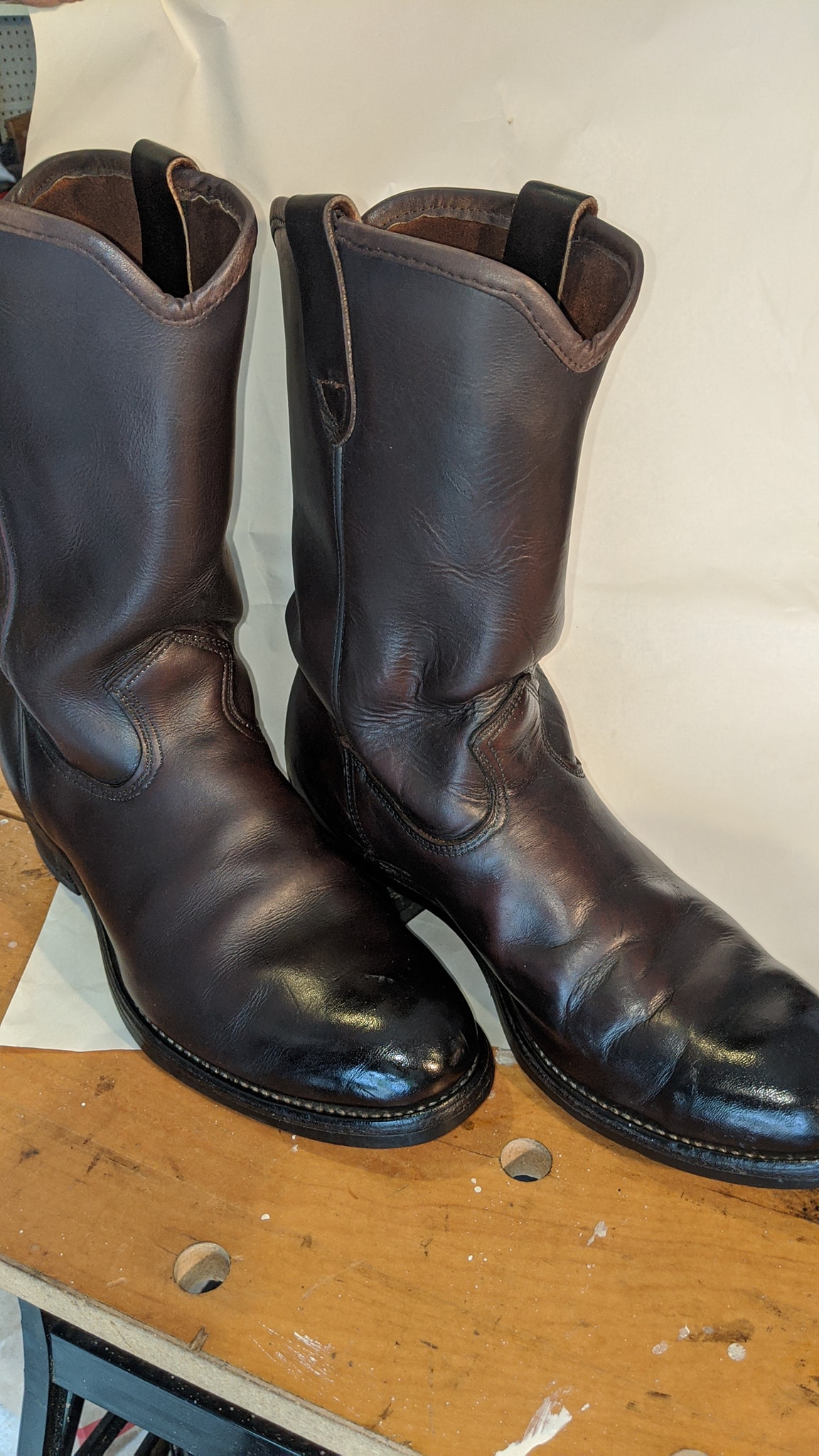
After a lot of vinegar, conditioner and cream they look a lot better. Pictures (also top image): Richard Satto / The Shoe Forum FB


I have experience mould growing on the leather sole of my shoe. live in the UK so it rains….a lot 🙁
This article made me think about how I store may shoes in their shoe boxes. I guess then, the best way to store quality leather shoes is in a storage unit with good air flow, no too much sun and in shoe trees (unless they are soaked and need to lose a fair bit of moisture). I need me a good shoe storage unit!
Thanks for the article.
Tony
Hi, I live in Brunei where the humidity is 90% all year round. I use a dehumidifier machine in the room where I store my shoes and it works great. Although the only con is I have to empty out the water collection container everyday.
Anthony Jones: Cheers! Yeah, if that’s the case storing them on some sort of carpet or similar to have air circulating under the soles would be good for sure.
Shahamir Shahrill: Good, yeah forgot about that part, added a section on moist absorbers or even dehumidifiers where one store the shoes.
Really awesome guide about cleaning suede shoes.
peroxide works wonders to get rid of mould too as it helps killing it, I use it by dipping a brush in it and brushing the shoes, specially on the sewing of the welts.
I find that storing shoes in cardboard shoeboxes aggravates the problem since the cardboard tends to just collect moisture, specially in a basement. I actually saw a big difference simply by storing shoes in plastic shoeboxes with a pouch of silica gel in each shoe (silica gel saturates with moisture so it needs to be regenerated periodically, microwave is one of the ways to regenerate it).
The problem with mould is not the mould itself though, its the smell. Once the shoe gets that smell it is impossible to get rid of it, none of the remedies written on the net help in most cases, even if they make a dry shoe passable as soon the shoe is worn in the rain and gets wet the smell of mould is back. and the shoes are a loss.
Antonio: Great comment! Peroxide sounds like a good solution indeed. Agree that smell can keep coming back, at least if it had been there for some time before one removed it, which isn’t pleasant.
I had a mold problem with winter boots that were stored, off season, under the bed.
When retrieving the boots, I discovered that a coating of mold had totally covered them.
The nearby shower had created an excessive humidity problem in the bedroom.
I managed to remove this mold.
The affected pair of Sorel pac boots are still going strong.
I placed silica desiccant pacs into the Sorel shoe box as well as all my other shoe boxes.
The article also mentions this simple, yet effective, preventative.
This easy solution has worked a charm, and has prevented any reoccurrence of mold.
Good website, Kudos!
Tim: Glad to hear you managed to save the boots! And glad you like the website.
Benzalkonium chloride. In Norway the most convenient source of this chemical is the solutions made for removal of outdoors mold and algae. These solutions should contain BZK, water and some ethyl alcohol or isopropyl alcohol. Ask the shops who sell paint. An example is «Butinox sopp- og algefjerner» in Norway.
A very diluted solution of this in a bucket should fix bad bacterial odour and stop the mold on anything that you submerge. If clothes or shoes float to the top you can use stones to make the clothes or shoes sink. Please do this outdoors with eye protection and gloves. Whatever you submerged will have to be rinsed with water to be safe. I have never done this to nice leather shoes, but I was able to make a cheap pair smell great again. The leather looked good after treating it with leather products. I’ve also done this for clothes and non-leather shoes where a bad odour would always return no matter what I tried. Benzalkonium chloride will work at room temperature. https://en.m.wikipedia.org/wiki/Benzalkonium_chloride
JOAR W, Would you think that Fantastik Spray Cleaner might do the job? It seems to have a similar chemical as an active ingredient. https://www1.mscdirect.com/MSDS/MSDS00069/42522037-20200419.PDF
I had purchased some shoes used that looked like they were in brand new condition, I didn’t wear them for quite a while when I put them on I noticed when I took my feet out that my feet were black! When I look inside the shoe, there was black mold inside them there is no mold anywhere else but inside both shoes! I have never had this problem with any other leather shoes that I have or have ever had. I do not have excessive moisture where I live. And this happened during the summer when it’s quite warm, I’m thinking that whoever I purchased them from may have had a mold problem.
Now I’m trying to figure out how to get the mold out as I am sure it’s probably underneath the inside soul and all in the stitching and I just don’t see how I can get that out.
They are very expensive shoes.
Maria: Sorry to hear. I’d follow the steps in this guide, which hopefully will resolve it.
Do you have any tips for mould removal from
Suede boots please? I’m nervous about using anything which might change the colour of the (dark blue) suede.
I have some leather that I can barely bare to throw away, but what stops me wiping is soaking it in vinegar or other sanitisers is the belief that even if I remove all the mould, the spores will still have impregnated leather and will immediately bloom again at the smallest chance, such as when the cleaned leather’s conditioned.
Pretty much nothing but autoclaving is going to kill the spores, so the only real option is abandoning them, or sealing them in, which probably wouldn’t be great for the leather, or permanent.