

Time for the substantial review of all 20 competition shoes that entered this year’s World Championships of Shoemaking. Info about the makers and the boots, comments, loads of pictures and, in some cases, photos of the manufacturing process. A close look at some seriously impressive black chelsea boots.
Pt.2 with positions 11-20 can be found here.
Go directly to list of contestants.
First of all, sorry that it has taken such a long time to get these articles out. A bunch of stuff that has happened this summer that has made my work with Shoegazing suffering a bit, especially time consuming stuff like this. Hope to be back on track for autumn.
Part of the London Super Trunk Show at the beginning of May was the seventh edition of the World Championships of Shoemaking (see here for more articles on this contest and summaries of previous years’ shoes), organised by Shoegazing, The Shoe Snob and Kirby Allison. The latter is also a funding sponsor of the contest, together with the book project Master Shoemakers and Parker Schenecker, brother of the shoe aficionado and contest co-founder Edmund Schenecker, who sadly passed away a few years ago.
They contribute the substantial prize money of £3,000 to the winner, £2,000 to second place and £1,000 to third place. As always, we organisers make no money at all from the contest, with the funds paid directly from the sponsors to the shoemakers. The podium finishers also receive handmade awls by Phil Norsworthy, plus gold, silver and bronze medals.
The top three chelsea boots will now go on tour around the world, together with a winning shoe from the World Championships of Shoe Patina, to be showcased to thousands of shoe lovers at various locations. As we always aim to do, the tour includes a mix of new locations and stores that have participated in previous years. The preliminary tour schedule is as follows:
| Week | Date | Store | City, country |
| w 36-37 | Aug 31-Sep 13 | Skomaker Dagestad | Oslo, Norway |
| w 39-40 | Sep. 21-Oct- 4 | Old House Provisions | Washington D.C., USA |
| w 42-43 | Oct. 12-25 | Kirby Allison | Dallas, USA |
| w 45 | Nov. 6-7 | Chicago Super Trunk Show | Chicago, USA |
| w 46-47 | Nov. 10-22 | Dashing Chicago | Chicago, USA |
| w 49-50 | Nov 30-Dec 13 | Isetan Men’s Tokyo | Tokyo, Japan |
| w 1-2 | Jan 4-17 | Bridlen Gallery | Chennai, India |
| w 4-5 | Jan 25-Feb 7 | Unipair | Seoul, South Korea |
| w 7-8 | Feb 15-28 | Decorum | Bangkok, Thailand |
| w 9 | Mar. 6 | Singapore Super Trunk Show | Singapore |
| w 10-11 | Mar 8-21 | CNES International | Singapore |
| w 12-13 | Mar 30-Apr 11 | The Hand | Amsterdam, Netherlands |
At the London Super Trunk Show, all 20 competition shoes were displayed for the more than 1,000 people who visited the event during the day. At the award ceremony in the evening, the top ten were presented. As always, the shoes and the competition attracted a great deal of interest and admiration, both at the event and afterwards.
This year, the contestants were tasked with making a black chelsea boot. Since the elastic gussets inevitably make the basic structure of the model relatively similar, the possibilities for the rest of the design were deliberately kept rather open. This resulted in a wide variety of interpretations, from elegant and relatively traditional boots to highly elaborate showpieces with advanced upper work, sculptural heels and unusual sole treatments.
For the first time, Originality was included as a separate judging category. The aim was to reward contestants who introduced new ideas and pushed the craft forward, rather than relying too heavily on details and solutions seen on successful entries from previous years. Together with Degree of difficulty, Execution and Design / aesthetics, this gave the jury a broader basis on which to assess the entries.

The jury gathered at The Valet in London for the jury review.
The day before the event, the shoes were reviewed anonymously by the jury, which consisted of:
Jean-Michel Casalonga, bespoke shoemaker
William Laborde, bespoke shoemaker
Emiko Matsuda, bespoke shoemaker
Sebastian Tarek, bespoke shoemaker
Vivian Saskia Wittmer, bespoke shoemaker
Athanase Sephocle, bespoke shoemaker at Berluti
Daniel Wegan, bespoke shoemaker
Kirby Allison, sponsor and founder of the Kirby Allison store
Gary Tok, sponsor and author of Master Shoemakers
Jesper Ingevaldsson, Shoegazing
Justin FitzPatrick, The Shoe Snob
The criteria set out for the competition shoes were as follows:
- Chelsea boot model, ankle high with elastic gussets on each side of the shaft, made from one to four pieces of leather. Decorative stitching, brogueing and punched holes were permitted but not required.
- One left shoe, size UK8 or corresponding size, with a maximum of two width sizes up or down from an acceptable standard width.
- Smooth black leather, either box calf or aniline dyed, with no patina.
- Leather sole.
- Hand welted construction and handmade sole stitching. The boot had to have a welt extending at least 270°, with a defined waist and the welt and sole stitching continuing along both sides towards the back of the heel. A blind welt at the waist was permitted.
- Black sole and heel edges, with a natural-coloured bottom. Decorations made with wheels, nails or similar techniques were allowed, but the bottom could not be dyed or burnished.
- A fully finished interior, including sock lining.
- No branding.
- Due to practical reasons, potential shoe trees would not be removed for the jury review, but were not part of the judging.
Errors in relation to the specifications could result in a deduction of 5% of the total score for smaller deviations and 10% for larger ones. An entry that did not follow the specifications at all could be disqualified.
The four judging categories were:
Degree of difficulty, maximum 10 points per jury member
The jury assessed the complexity of the construction methods used and how advanced the work was, both in its main construction and in smaller details.
Execution, maximum 10 points
The jury assessed how well the different parts of the boot had been made, the neatness and precision of the craftsmanship, and the quality of the finishing.
Design / aesthetics, maximum 5 points
The jury assessed the overall appearance of the boot, including its proportions, balance and visual coherence.
Originality, maximum 5 points
The jury assessed how distinctive the design, construction solutions and finishing details were compared with previous competition shoes and footwear in general.

The top ten shoes brought up on the stage in London ahead of the award ceremony.
And here you can view the whole award ceremony in London, hear last year’s world champion Louis Lampertsdörfer’s thoughts about the top shoes, and more:
So, below is first the full list of results, followed by a walkthrough of all 20 competition shoes, from position 1 to 20, with positions 1-10 in this article and 11-20 in the second part linked in several places here. It is highly recommended to look through everything carefully and study the photos to properly appreciate the amount of work involved.
This year once again showed how the general level is really high, but also how differently the criteria can be approached. Some entries achieved their results through exceptionally clean execution and beautiful proportions, while others pushed the limits in difficulty, construction and originality. Together, they form a fascinating overview of what some of today’s most skilled shoemakers can accomplish by hand.
.
Results
(Click on maker/brand to go directly to summary, go here for positions 11-25)
1. Ken Kataoka
2. Twinkima.G
3. Dmitry Avdyukhov
4. Sébastien Decaix
5. Andrey Kaveshnikov
6. Qingshan Studio
7. Attila Kovacs
8. Reid Elrod
9. Reo Okuda
10. Larush
11. Kim Junghwan
12. Peace Andoh
13. Naang Boots
14. Ross Edwin Bell
15. Shid
16. Anietie Ette
17. Petru Claymoor
18. Taichi Yasuda
18. Natalia Iokhvidova
20. François Jardé
.
1. Ken Kataoka

Un unmistakable piece, the world champion shoe of 2026.
Third time’s a charm, as they say. The Japanese maker Ken Kataoka has finished second in the contest two times, in 2022 and 2025. Both those entries were spectacular showpieces with a vintage feel over them, both had very elaborated heel work. This year he kept that recipe, just raised the level even further. And finally, he could take the top podium position and become the world champion.

Sole with “bumpy art” bottom.
The winning shoe is a sensational one. The shape is highly sculptural, with an exaggerated Victorian form, both of the last and then of the stunning heel. It’s certainly a divider when it comes to the look, but the craftsmanship and skill needed to build this heel can’t be questioned.
– The heel shape is what I’m most pleased with. I feel it allowed me to maintain a classic silhouette while giving the overall outline a dynamic quality at the same time, says Ken Kataoka.
The upper features a Victorian flowering design, that requires a steady hand with the sewing machine to follow the intricate pattern. Has a bevelled waist and “bumpy art sole”, and the vintage feel continues with the thin sole and the very fine sole stitching.

Layer after layer of thin leather lifts have been built and shaped to achieve this.
The shoe scored very high on difficulty, execution and originality, a bit less on design / aesthetics. On the latter category, it divided also the judges, where some didn’t appreciate the special look as much as others. But this year, the win was clear, after a few tight years we had a winner that no one else could touch this round. After Ken was announced the winner, he received a lot of praise.
– I’ve received so many messages from people, it has been wonderful to be celebrated like this, Ken says.
Based in Asakusa, Tokyo’s historic shoemaking district, Ken Kataoka is part of a new generation of Japanese bespoke shoemakers. He previously presented his work under the name Siroeno Yosui, but is now transitioning to using his own name. His training includes studies under acclaimed shoemaker Noriyuki Misawa. Kataoka has also reached a wide international audience through his YouTube channel, where the entire process of making bespoke shoes is documented in detail. The channel, one of the largest of its kind, is produced together with his brother, who is responsible for filming and editing.

Well-executed sole stitching.

Shapes.

From the back.

The interesting sole work.

Lovely upper making, even if this was one part that Ken Kataoka himself was less pleased with.

The breast is carved into the heel.

Enhanced hump.

Inside.

Some images from the making, all shot by Ken Kataoka. Here’s the lining is being blocked.

The one piece upper is being blocked.

Upper lasted.

The welt stitching is done.

Here he hass begun to work on the heel.

Further in the process. Here all the pars above the sole has been built, so next he’s attaching the sole.

Look at the sole stitch.

The cool sole, and some of the tool’s used in the background on the table.
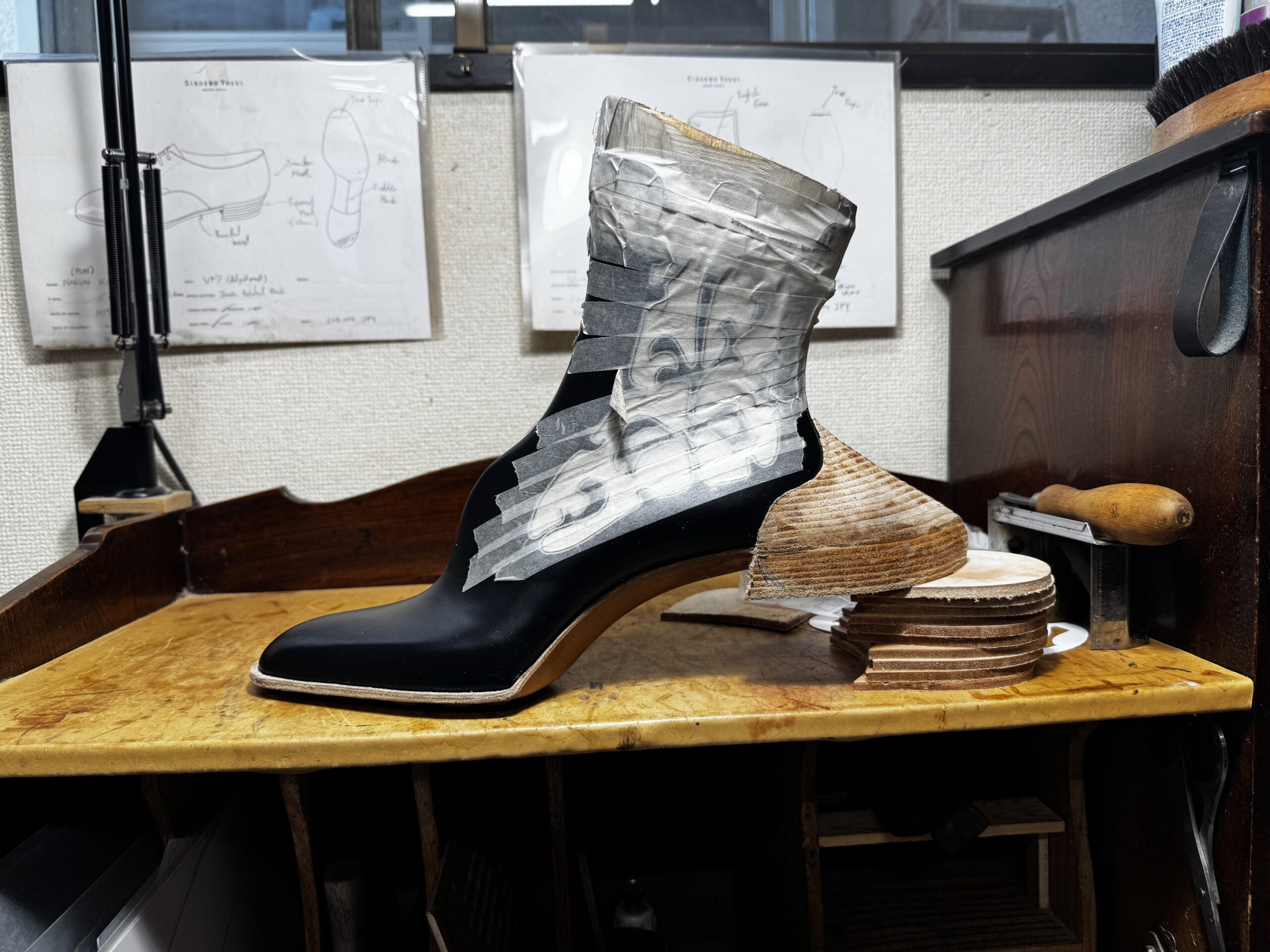
Such tough work.

Here the whole heel except the top lift is built, but just pre-shaped.

Almost finished.
.
2. Twinkima.G

Twinkima’s second placed shoe is a more traditional take on the chelsea.
One of the things that I’ve appreciated with the the world championships of shoemaking ever since the start, is the mix of more crazy showpieces and much more toned down classic work, and the fact that every podium have consisted of both types. This year is a very good example, with the first placed being a true exhibition shoe, this second placed one a very classic shoe that could a regular bespoke sample, and third somewhere in between.
But if you make something as well-made and thought through as Twinkima.G has, it can take you this far. What’s interesting is that Twinkima is a factory that normally make mainly RTW shoes, albeit fully handmade ones. It was founded by Meng Guan as late as 2019. They have its own factory in Dongguan in southern China, where they make both hand welted classic shoes as well as more casual espadrilles and other things. And the skill of the factory workers is obviously really high.

Also bottom has a classic base, but lovely decorations.
The team behind the shoe are the following persons, who all are full time employees in the Twinkima.G factory: Yukun Zhang – organiser, Jay Chu – lastmaker and shoe designer, Jack Wang – bottom maker, Daniel Lee – carving artisan specialist, and Felix Yip – shoe shine.
Now, on to the shoe. The upper is built with hidden seams and a pattern that makes i almost look like there’s a shaft in the shaft so to speak. It has personal character, even if the base is classic. It has panels on the elastics makes it more minimalistic. The bottom is equally toned down at first, but has some amazingly beautiful decorations on both the sole part and heel. These are hand compressed with various wheels.

Distinctly made, super sharp.
Overall what really stands out with this shoe is the execution. It’s more or less perfect in every detail, as precise and sharp as hands and tools can shape leather into. We’ve had a few of these shoes on the podium through the years, where they scored high in many categories, but exceptionally high on execution. For example Eiji Murata’s third place in 2019 or Wataru Shimamoto’s winning shoe from 2022 scored very high in this category. Twinkima.G’s is another one of these.
Also on design / aesthetics it’s on top level, while a bit lower on difficulty and originality. But goes to show, that super skilled making and a visually pleasing shoe can take you really far in this contest. I’m happy we continue to see very different types of shoes taking top spots.

The pattern sort of makes it looks like the show is growing out of itself, so to speak.

Back.

Inside.

Close up of the sole decoration.

And heel.

Hidden elastics.

Seamless back.

Shots from the making. Here’s the plan for the shoe.

Upper finished.

And here it’s lasted.

Welting.

Prepping the waist build.

Stitching the sole.

Not much left here, only some work on the sole. And yes, apparently they made a sibling as well, which is pretty cool.
.
3. Dmitry Avdyukhov

Another great showpiece.
Third place shoe is, as mentioned above, sort of a mix between the gold and silver placed ones. It also has the Victorian era inspiration and some highly artistic parts as Ken’s shoe, but the overall look is more classic and wearable one as Twinkima.G’s. Of course the moc lacing is what immediately strikes you, but there’s so much more to discover.
The shoe is made by Dmitry Avdyukhov who is a bespoke shoemaker from Kalach-on-the Don of the Volgograd region in Russia. Dmitry Avdyukhov was responsible for making of the last, pattern making, upper making and bottoming. He had help by Evgeny Tabunshchikov who made the stacked leather heel and the brass decorations.

The work that has gone into making this shoe is surely something.
The shoe has several advanced features. Large section of the upper is seamless, and the elastics has been hand-woven on a loom Dmitry has built himself. Also the inside has cool quilted pieces that are really worked through. Sole has s a super fine 24 spi (stitches per inch) sole stitch, and heel is built with several layers of 2 mm thin lifts.

Urushi lacquered toe tap.
On the bottom it has an incredibly nice looking brass toe and heel plates decorated with urushi lacquer, with crushed mother of pearls embedded creating the lives. The decorative lacing gives it a balmoral boot look, which is a nice thing given that the chelsea when invented had its base in a lace-up balmoral boot.
The boot received evenly high points in all categories, difficulty, execution, design / aesthetics and originality. Not full scores on all but jury was certainly impressed with all parts of this shoe. Given that Dmitry Avdyukhov spent around a whopping 300 hours on the shoe (included stuff like a fully hand stitched upper that was damaged when lasted, so he had to remake it only partially handmade) it’s a well-deserved podium.

Doesn’t look like a chelsea boot from this view.

No seam back of the main piece.

Own-made elastics.

24 spi.

A beautiful boot.

Faux lacing.

Over to some images from the making. The last was carved from this block.

Blocking.

Blocked.

After welting.

Excellently made sole stitching.

The homemade loom which the elastics are made on.

Close-up.

The pattern for the elastics on the finished base.

Heel being built.

Refining it.

Working on the heel top piece.

Urushi lacqeur is messy.

Crushed mother of pearls being embedded.

Not the easiest pattern to cut out from the sole.
.
4. Sébastien Decaix

A chelsea that looks pretty basic from this view, but it’s deceiving.
Sébastien Decaix is s French bespoke shoemaker who grew up in Japan, apprenticed under Philippe Atienza in Paris, and trained lastmaking at John Lobb Paris. He just recently launched his own brand, and a pretty good way to kick things off by showcasing the skills by finishing 4th in the world champs. For the making, the pattern-cutting and stitching of the upper:was made by Claire Daubé, straw marquetry and inlaid metalwork by Alexandre Mouret and Patrice Lejeune, Théodore Mkrttchian did the blocking, the rest was made by Sebastien Decaix. Apart from the shoe tree that Hervé Brunelle, not part of judging though.

The sole continues over the breast of the heel and over as heel top piece.
The shoe features some advanced construction details where the heel stiffener was hand-sculpted and aligned with the heel pieces, which is very intricate and impressive work. The heel and and sole edges are covered in black straw marquetry, the outsole was made as a single complex piece, nicely executed 18 spi sole stitch, and so on. It lost out a bit on design / aesthetics.

The brilliant and highly unique back part.

Side view.

Advanced toe tap.

It’s like the back part has a black hole that everything is pulled towads.

Prepping the heel stiffener piece.

Carved out.

Placed on the stiffener.

Skin stitching the upper.

Tough work to shape this out.

Welted.

Similar technique as on the heel is used to create the “wings” of the waist.

The sole. And heel top piece.

Getting the sole in place.
.
5. Andrey Kaveshnikov

Showpiece shoe.
Here we have a superbly made showpiece of a boot. The upper is made using a special old Russian technique called Kazan (ichig), it has a 23 spi sole stitch, and it has a charming poled heel, perhaps inspired by some old contest shoe in the archive of the Northampton shoe museum I shared on Shoegazing a while back. It scored high in all criteria categories.

Mosaic sole.
The man behind the brand Moscow Shoemaker, Andrey Kaveshnikov, is a stable top ten finisher in this contest, and this year he was closer than ever to the podium. Was actually one point away from third, but after discussions in the jury we sadly needed to add a 5% deduction due to the mosaic on the sole, since it’s stated that the sole should not be dyed and this doesn’t follow that. A shame cause the mosaic was lovely made. Andrey made all himself.

Pillar heel.

Decorative leather rose on the side of the shaft. Seamless heel.

Upper hand stitched using the Kazan technique.

Old school last shape.

Lovely, but sadly not following the rules fully.

From the making, here upper parts prepped.

Working on the special Kazan stitching of the uppers.

Sole stitching done.

The base of the heel is being built.

Further into the process.

The leather boards that he turned into mosaic.

This sensational boot tree wasn’t part of the judging, but worth showing anyway. It’s dried flowers embedded into plastic resin.
.
6. Quingshan Studio

A chelsea with a lot of things going on.
A boot with a special baboon-style back where the sole continues upwards, a split heel, and some other cool features, resulting in good originality points. Norwegian stitching around the back part. One also have to appreciate the open channel sole, it’s very rare to see on fully handmade items but adds a nice touch, and to have hand stitched sole stitching look good on both ends isn’t the easiest.

From below, with the ridge fiddle back waist following up along the heel.
Qingshan Studio is a father and son duo from China. They finished 19 in 2023, so improved a lot for this year. Linlin Wang made the upper making and finishing, with his father Zhencheng Wang doing the pattern making, lastmaking and bottoming. They do not seem to have any online presence, from what can find.

Baboon style.

Shapely.

Open channel sole.

Back view.
.
7. Attila Kovacs

Stylish and classic look.
A relatively classic and sleek looking chelsea boot, with some intricate details. Scored high on difficulty with the seamless wholecut upper, hand braided upper top line stitching etc. A very cool built in pocket watch mechanism in the heel, which is fully functional. Lost out a bit on execution.

Rebellious solution at the back of the very slim waist waist, that did follow the rules though. Here you see the pocket watch built-in.
Attila Kovács has been making shoes in Hungary since 1991, and do handmade RTW, MTO and also bespoke. He has through the years successfully participated in numerous Hungarian and international shoemaking competitions, and like the creativity that contest shoes can bring out. Attila Kovács made all himself.

Back beauty.

Magnificent elastics with hand braided seam following along.

Watch also on top, only decorative this one though.

The wide elastics gives it character.
.
8. Reid Elrod

May not look like a chelsea boot, but it is one.
Very cool boot, with several things that makes it stand out. The faux lacing is combined with the vintage style elastics, with a super thin leather split draped over elastics, which makes it blend into the upper. Then on the bottom we have a very well-made leather-made tread pattern on the sole. Maybe inspired by a Christophe Corthay contest shoe a few years back.

A rubber sole style thread pattern has been made with the carved out sole and leather pieces.
Reid Elrod, made all himself. He’s a bespoke maker based in Portland, USA, even if he trained in Europe. He has been part of the contest before and always make interesting takes of the shoe styles that are to be made.

Norwegian stitching combined with a storm welt.

A tall boot.

The leather covered elastics have been made very large to blend in to the pattern.

Great sole.
.
9. Reo Okuda

Diamond cap and a very low elastic.
Reo Okuda is a prosthetist and orthotist shoemaker based in Tokyo, Japan, who also do outwork. This is his second consecutive top ten position in the world championships. He made the entire boot himself, while Go Ishimi polished them.

Neat and classy.
The boot’s contrasting upper stitching with the diamond cap gives character. Nice stuff like sole stitched at 18 spi and the slightly Cuban-shaped heel built up with 2 mm leather layers gave good difficulty points.

Seamless back.

The low elastics change the appearance a lot.

Diamond cap, with hand braided decoration.
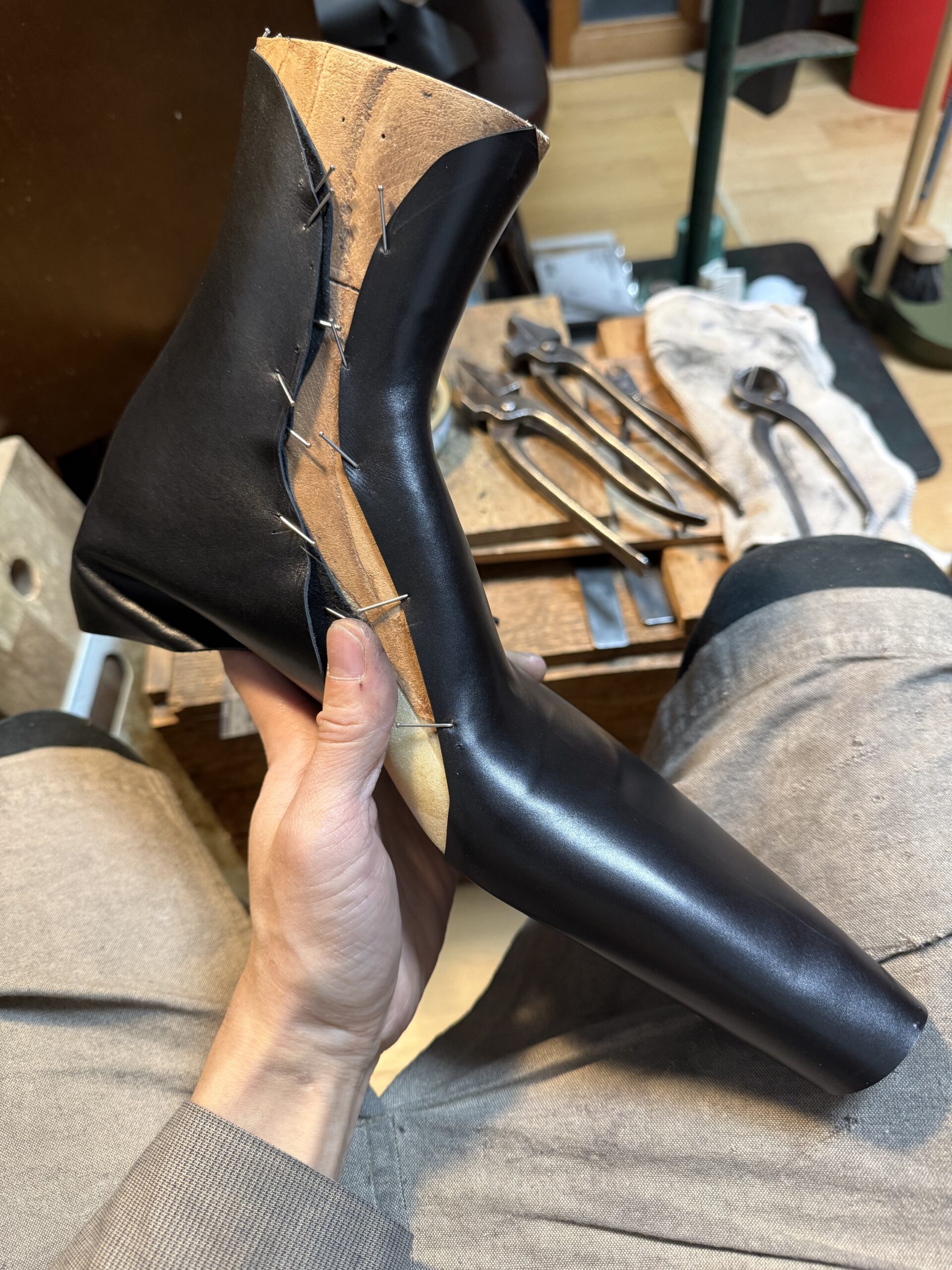
Blocking the front and back part.

Hand braiding.
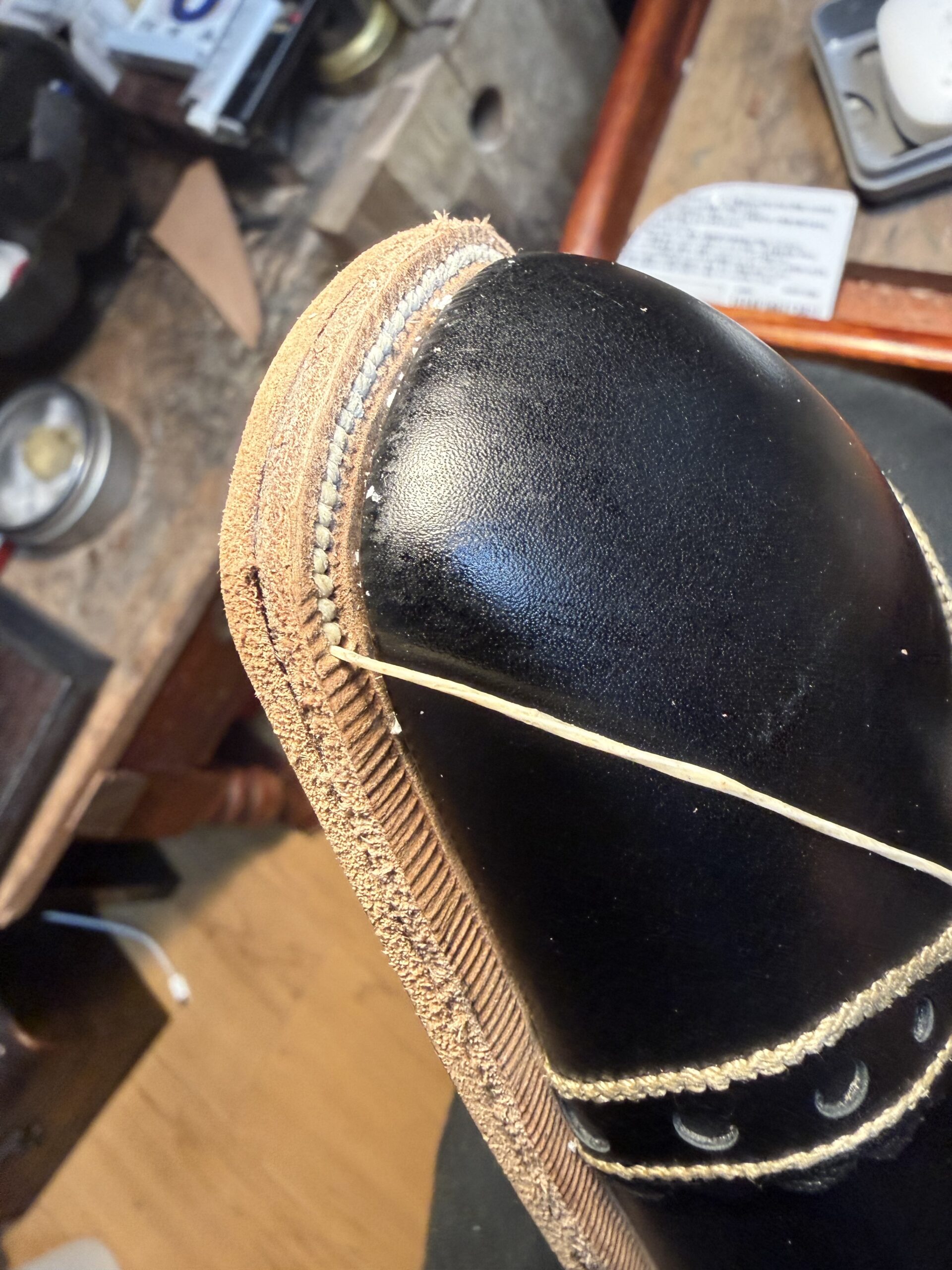
Stitching the sole at 18 spi.
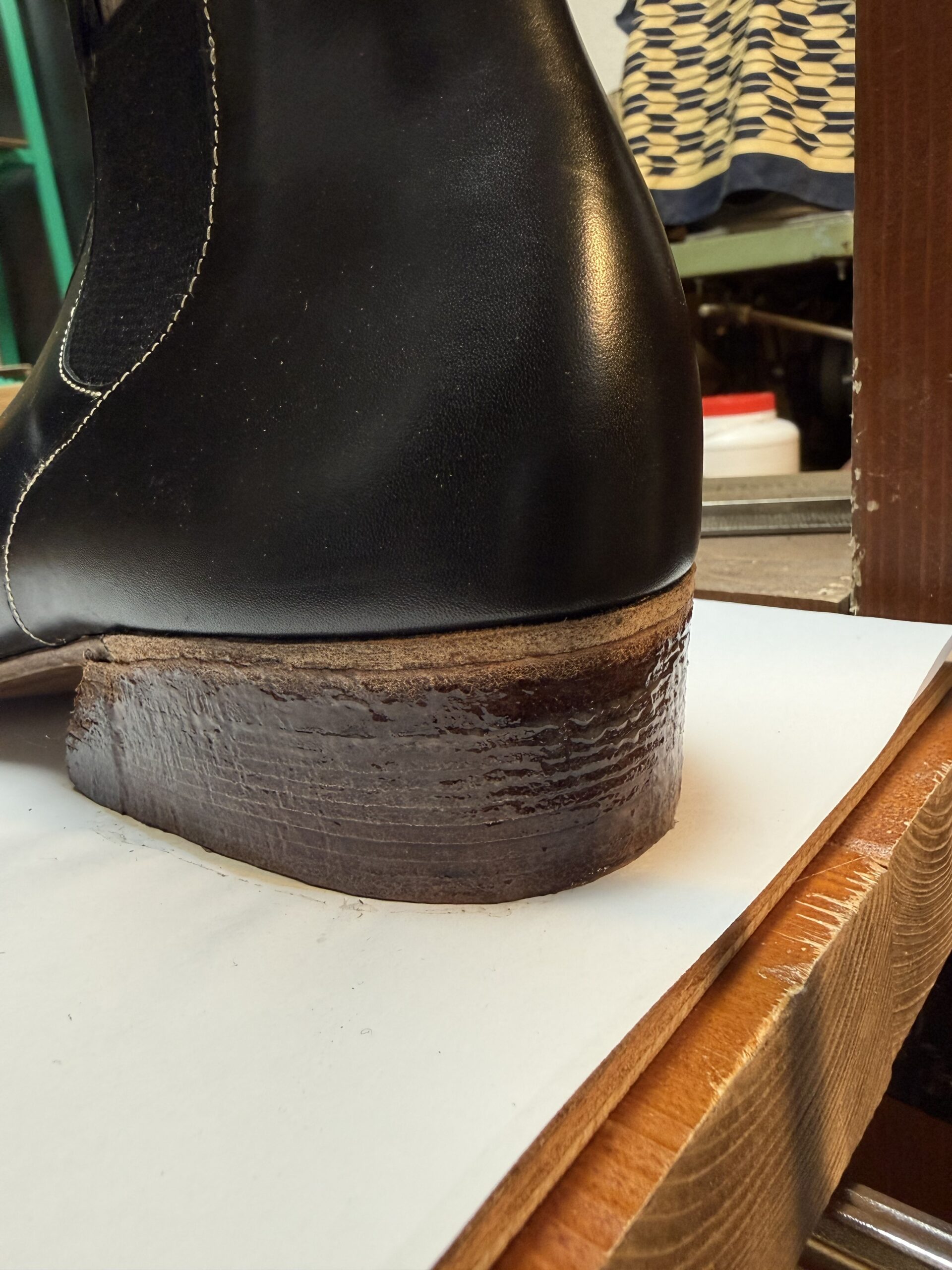
Heel building.
.
10. Larush

Aggressively styled boot.
Larush is a brand of the Russian shoemaker Alex Dernov, didn’t give more info and I haven’t been able to find more. A very cool, aggressive looking boot with a special upper design. Heel and back are very inspired by Daniel Wegan’s winning shoe a few years ago, which meant less points in the originality criteria. Alex made all himself.

Nice bottom, but not the most unique one.

Ridged back.

Very fine sole stitching.

Chunky stance.

Close-up of the heel.

Sole channel opened up.

Many have to invent new techniques and tools when they make their contest shoes, like this sanding apparatus.

Hard to reach this area with your regular tools.
Continue to part 2 with positions 11-25 here.


Thank you for also including the photos of the making! It elevates the whole thing, so interesting to see.
Gavri: Glad you think so! It’s great that many makers include this, have to be a bit selective on how much we can include to just due to time constraints, but try to share quite much from the top ten.